The book
Surrogate Entrepreneur
An idea begins with one person. Then more people believe in it — and everything around the decision changes. This is a book about what happens next.
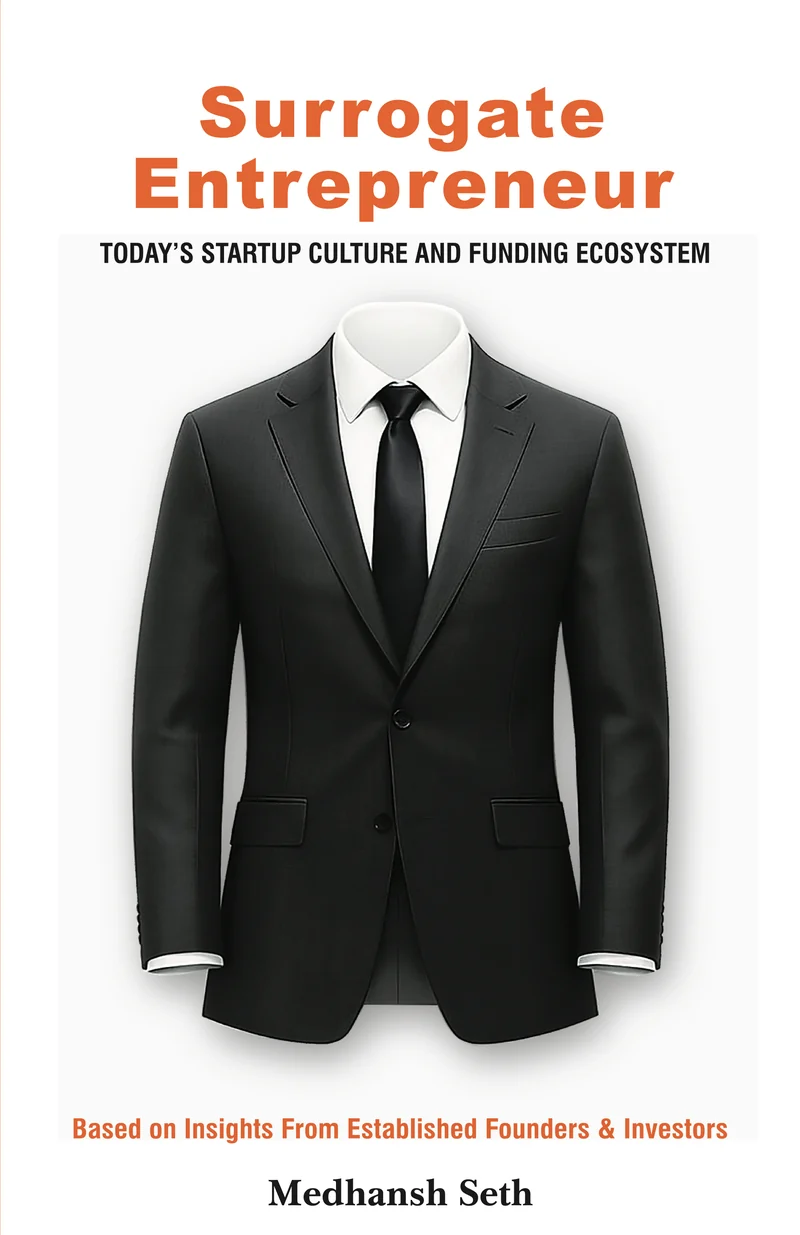
The suit is on the cover for a reason.
The role is occupied. The question is by whom.
What it is about
An idea starts with one person. Then someone believes in it, and then a few more. Belief brings talent, knowledge, reach and capital. It also brings expectations, timelines and people who now depend on the outcome.
None of that is a problem. It is what growth is. But it changes the environment around every decision the founder makes — and almost nobody talks about that part in public.
Surrogate Entrepreneur is set inside today’s startup culture and funding ecosystem, where that shift happens fastest and most visibly. Funding is a large part of the story. It is not the villain of it. Medhansh Seth asked established founders and investors what actually changes after the announcement, and wrote down what they told him.
What it covers
- The funding effect — what changes the day the money lands
- Dilution, ownership and the difference between a share and a say
- Growth at any cost, and what it quietly costs
- Boards, investors and the arithmetic of approval
- Why clarity, not capital, is so often the thing that runs out first
- What founders say in private that they do not post
Who it is for
Founders and aspiring founders. Operators and early employees. Students and people considering starting something. Investors and business readers who want the view from inside. Anyone who has read a funding announcement and wondered what the next morning looked like.
- Title
- Surrogate Entrepreneur
- Subtitle
- Today’s Startup Culture and Funding Ecosystem
- Author
- Medhansh Seth
- ISBN
- 978-93-5525-582-2
- Language
- English
- Status
- Publication date to be announced
Frequently asked questions
- What is Surrogate Entrepreneur about?
Surrogate Entrepreneur explores the realities behind modern startup culture: funding, valuation, founder psychology, ambition, pressure, risk and what actually happens after the headlines disappear.
It looks beyond the glamour of fundraising to ask a more important question: are you building something valuable, or simply something valuable on paper?
- Why should I read Surrogate Entrepreneur?
Because most people learn about startups from the winners.
You see the funding announcement, the valuation, the founder interview and eventually the exit. You rarely see the decisions, incentives, pressures and mistakes underneath them.
Surrogate Entrepreneur helps you understand that hidden layer. It gives you a framework for thinking about capital, growth, valuation and founder decision-making before you find yourself making those decisions.
Whether you want to start a company or simply understand how startups really work, the book is designed to make you look at entrepreneurship differently.
- What makes this different from other entrepreneurship books?
Most entrepreneurship books teach you how to build, how to grow, how to raise money or how someone else succeeded.
Surrogate Entrepreneur asks what happens after you start playing that game.
What happens when raising money becomes a measure of success? When valuation becomes validation? When growth expectations influence decisions? When the founder who created the company begins adapting to the system around it?
Instead of giving you another formula for success, the book examines the forces shaping founders and startups in the first place.
- What is the central idea behind the book?
One of the book’s central ideas is the Funding Effect: capital is an accelerant, not a cure.
Money can help a strong business grow faster, but it can also allow weak decisions, broken systems and bad habits to scale faster. Funding does not automatically fix a startup. It amplifies what is already there.
- What does the book say about valuation?
A high valuation tells you what investors are willing to value a company at. It does not automatically prove that the company has created lasting value for its customers, built a sustainable business or solved its underlying problems.
Surrogate Entrepreneur challenges the tendency to treat fundraising and valuation as the ultimate scoreboards of entrepreneurship.
- Is the book against startup funding?
No.
The book does not argue that founders should avoid capital. It questions the obsession with capital and the assumption that raising money is, by itself, evidence of success.
Funding is a tool. Whether it strengthens or weakens a company depends on how, why and when it is used.
- Is this a book about how to raise venture capital?
No. It is about understanding what funding does to a startup.
The book looks at the incentives, expectations, pressures and behavioural changes that can accompany capital, rather than simply teaching you how to pitch investors or close a funding round.
- Is this a motivational entrepreneurship book?
Not in the traditional sense.
There are no promises of overnight success, billionaire formulas or recycled “hustle harder” advice.
Surrogate Entrepreneur looks at entrepreneurship more critically, including the parts that are usually left outside the success story.
- Who is the book for?
It is especially relevant for students, young entrepreneurs, first-time founders and people curious about startups.
But you do not need to be building a company to read it. Anyone interested in business, startup culture, venture capital, founder decision-making or the psychology behind entrepreneurship can engage with the ideas in the book.
- Do I need to understand finance or venture capital before reading it?
No.
The book is designed to make ideas around funding, valuation, founders, investors and startup incentives understandable without requiring a finance degree or years of startup experience.
- Is the book only about successful startups?
No.
Success stories are only one part of entrepreneurship. The book is interested in the decisions, pressures, mistakes, incentives and systems underneath the outcome, not just the companies that eventually make the headlines.
- Why focus so much on funding?
Because funding has become one of the most visible symbols of startup success.
Funding announcements generate headlines. Valuations become status symbols. Raising a round can sometimes look more impressive than building the business itself.
The book asks what happens when the means of building a company starts being mistaken for the purpose of building one.
- Is Surrogate Entrepreneur an autobiography?
No.
The book comes from Medhansh Seth’s perspective as a young entrepreneur, but it is not a memoir. It combines that perspective with observations, research and conversations around founders, businesses and the startup ecosystem.
- Why write about entrepreneurship from a young founder’s perspective?
Because young people often encounter entrepreneurship through its most polished version: funding announcements, valuations, exits, viral founder stories and overnight success narratives.
Surrogate Entrepreneur approaches that world from the perspective of someone entering it, questioning it and trying to understand what lies underneath it.
- Is the book only relevant to India?
The Indian startup ecosystem forms an important part of the context, but the questions are broader.
Capital, incentives, founder pressure, valuation, growth and the difference between appearing successful and building something sustainable are not uniquely Indian problems.
- What will I take away from the book?
Not a ten-step formula for building a unicorn.
The goal is to leave you with better questions about why you are building, when you should raise, what capital can actually solve, what it cannot solve, and how to distinguish genuine value creation from the appearance of success.
- When is Surrogate Entrepreneur published, and can I pre-order it?
The publication date has not been announced yet, and the book is not yet available to order. Leave your email on the first-to-know page and you will hear first: once when it is published, and once when it is out.
- Who has read it before publication?
Seven founders, operators and investors: Dr. Ritesh Malik, Kishore Biyani, Ankur Warikoo, Dinesh Gulati, Abhiraj Malhotra, Arjun Seth and George Paul. Their words are on the advance praise page, exactly as they wrote them.
- What is the ISBN?
978-93-5525-582-2.
Seven founders and investors read it first.